









































New to KubeDB? Please start here.
Elasticsearch Vertical Scaling
This guide will give an overview on how KubeDB Ops-manager operator updates the resources(for example CPU and Memory etc.) of the Elasticsearch.
Before You Begin
- You should be familiar with the following
KubeDBconcepts: - Elasticsearch
- ElasticsearchOpsRequest
How Vertical Scaling Process Works
The following diagram shows how KubeDB Ops-manager operator updates the resources of the Elasticsearch. Open the image in a new tab to see the enlarged version.
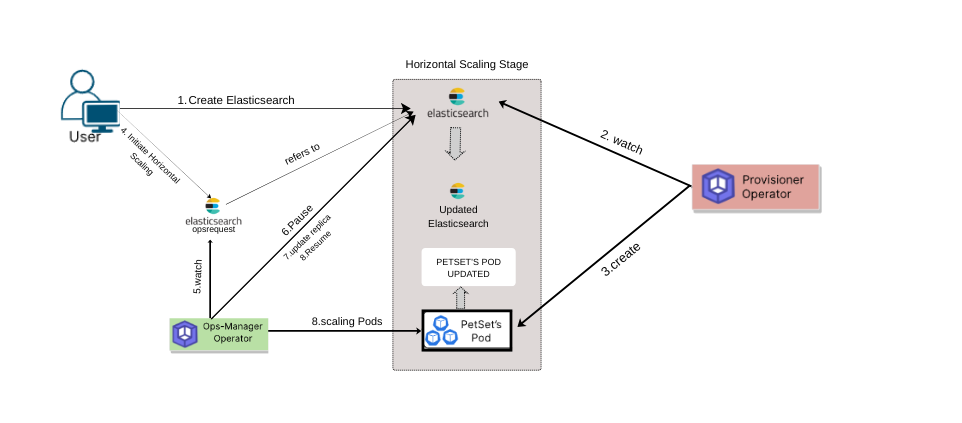
The vertical scaling process consists of the following steps:
At first, a user creates a
ElasticsearchCustom Resource (CR).KubeDBProvisioner operator watches theElasticsearchCR.When the operator finds a
ElasticsearchCR, it creates required number ofPetSetsand related necessary stuff like secrets, services, etc.Then, in order to update the resources(for example
CPU,Memoryetc.) of theElasticsearchcluster, the user creates aElasticsearchOpsRequestCR with desired information.KubeDBOps-manager operator watches theElasticsearchOpsRequestCR.When it finds a
ElasticsearchOpsRequestCR, it halts theElasticsearchobject which is referred from theElasticsearchOpsRequest. So, theKubeDBProvisioner operator doesn’t perform any operations on theElasticsearchobject during the vertical scaling process.Then the
KubeDBOps-manager operator will update resources of the PetSet Pods to reach desired state.After the successful update of the resources of the PetSet’s replica, the
KubeDBOps-manager operator updates theElasticsearchobject to reflect the updated state.After the successful update of the
Elasticsearchresources, theKubeDBOps-manager operator resumes theElasticsearchobject so that theKubeDBProvisioner operator resumes its usual operations.
In the next docs, we are going to show a step by step guide on updating resources of Elasticsearch database using ElasticsearchOpsRequest CRD.